Hydrotropism Research Workflow
Problem
The doctoral research investigated how maize primary roots respond to water gradients and how physiological and genetic factors contribute to that response. The technical challenge was to turn a controlled, time-dependent biological response into measurable traits, suitable analyses, interpretable figures, and carefully bounded conclusions.
Experimental system
A Hydrotropism Analyzer research system was developed and applied for controlled, quantitative measurement of root bending and related traits.
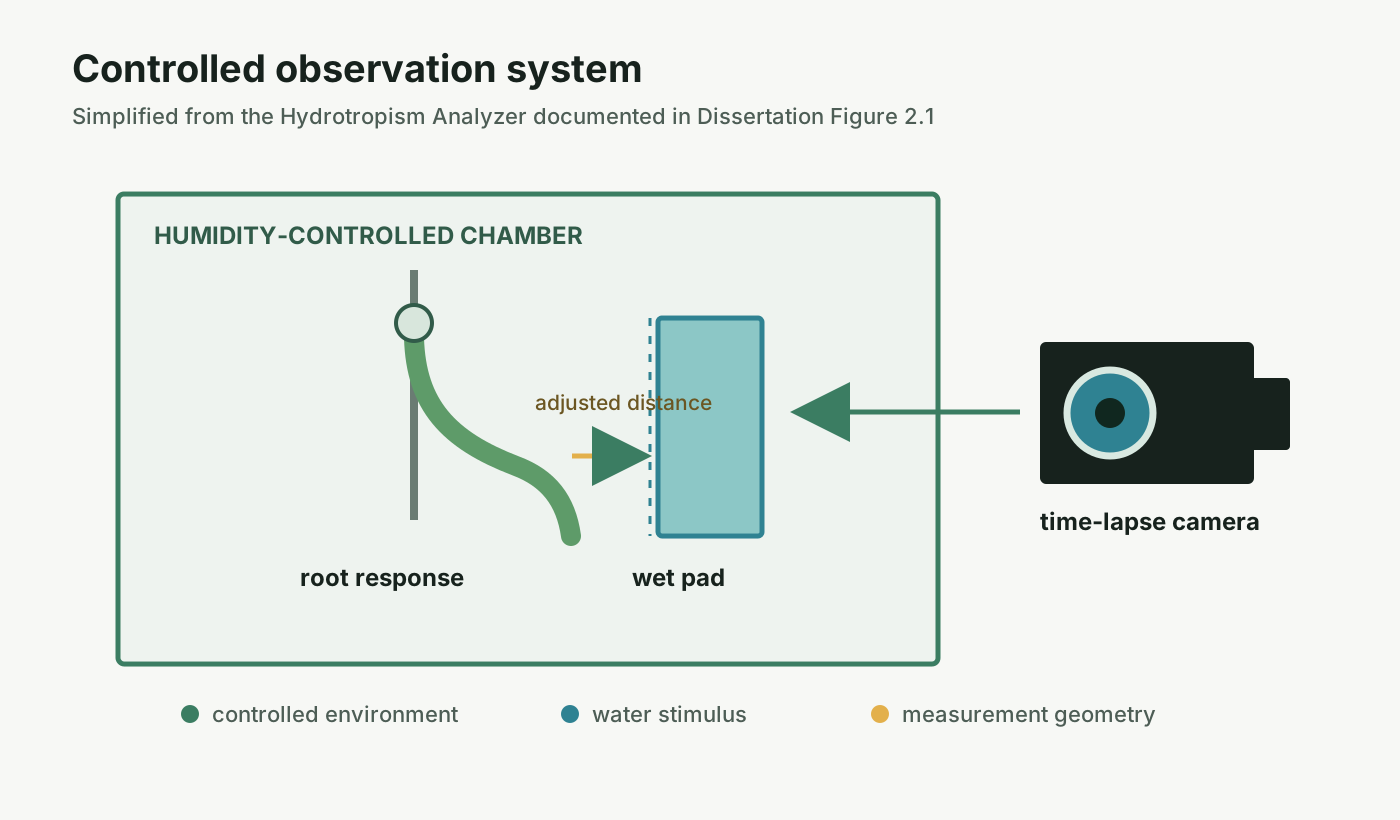
Simplified from Dissertation Figure 2.1.
Measurement
Image and video records followed root responses over time. ImageJ, SMARTROOT, and IC Measure converted observations into quantitative traits; this is not described as a fully automated computer-vision pipeline.
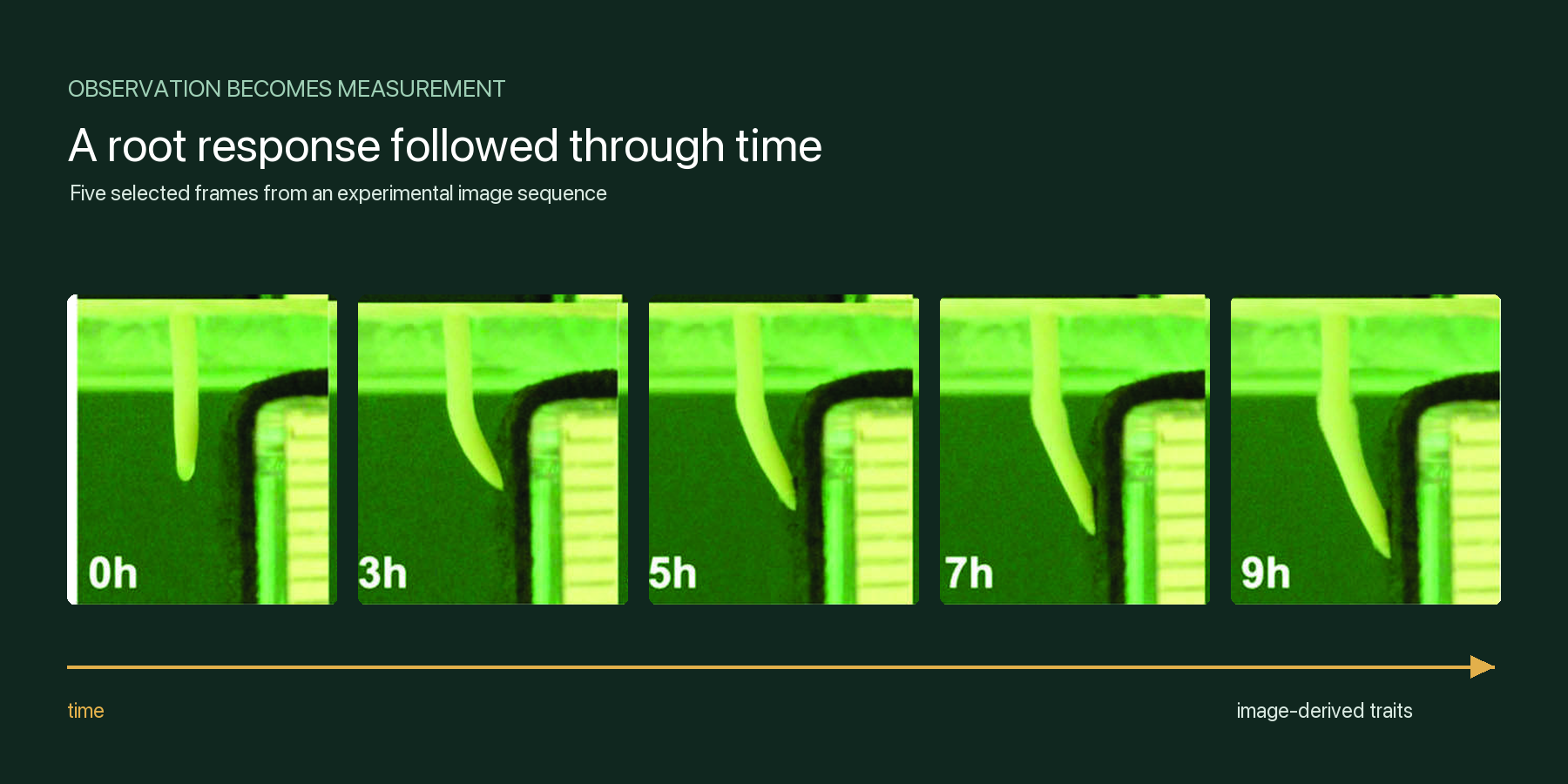
Selected time points from Dissertation Figure 2.2.
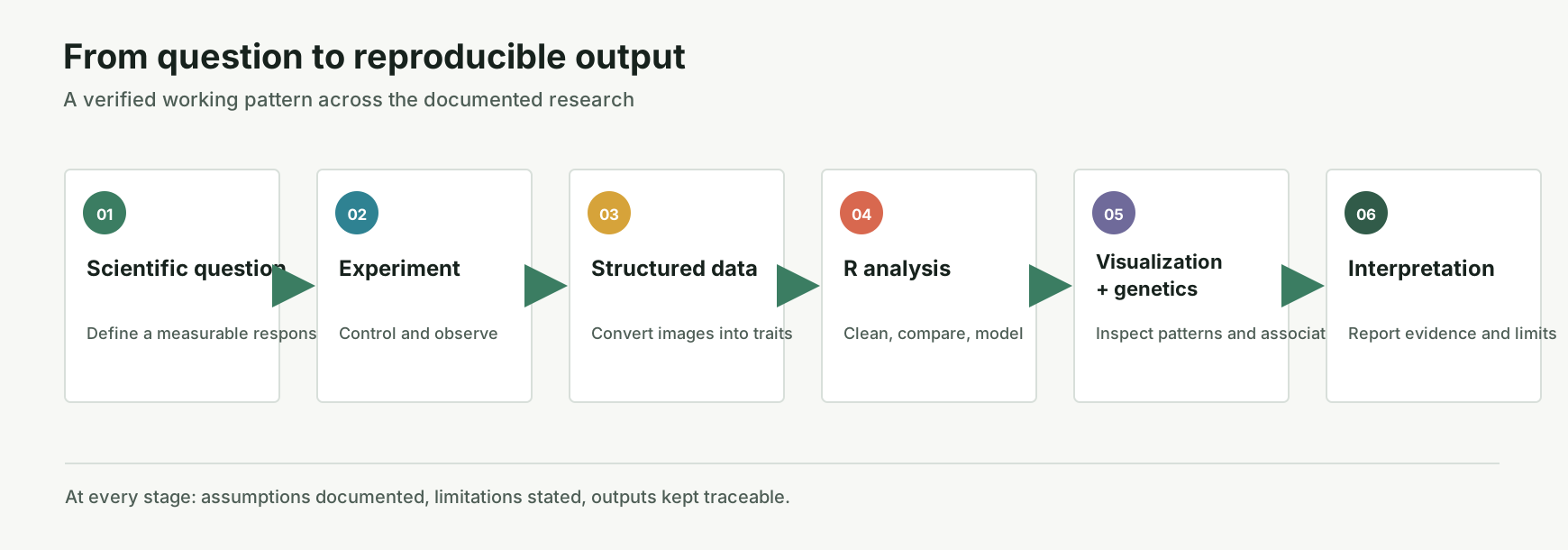
Diagrammed from the verified research workflow.
Analysis
R workflows addressed repeated measurements, treatment and species comparisons, related traits, biological variation, and uncertainty. Documented methods included experimental comparisons, correlation and principal component analysis, mixed models, logistic regression, bootstrap resampling, and multiple-testing correction where appropriate.
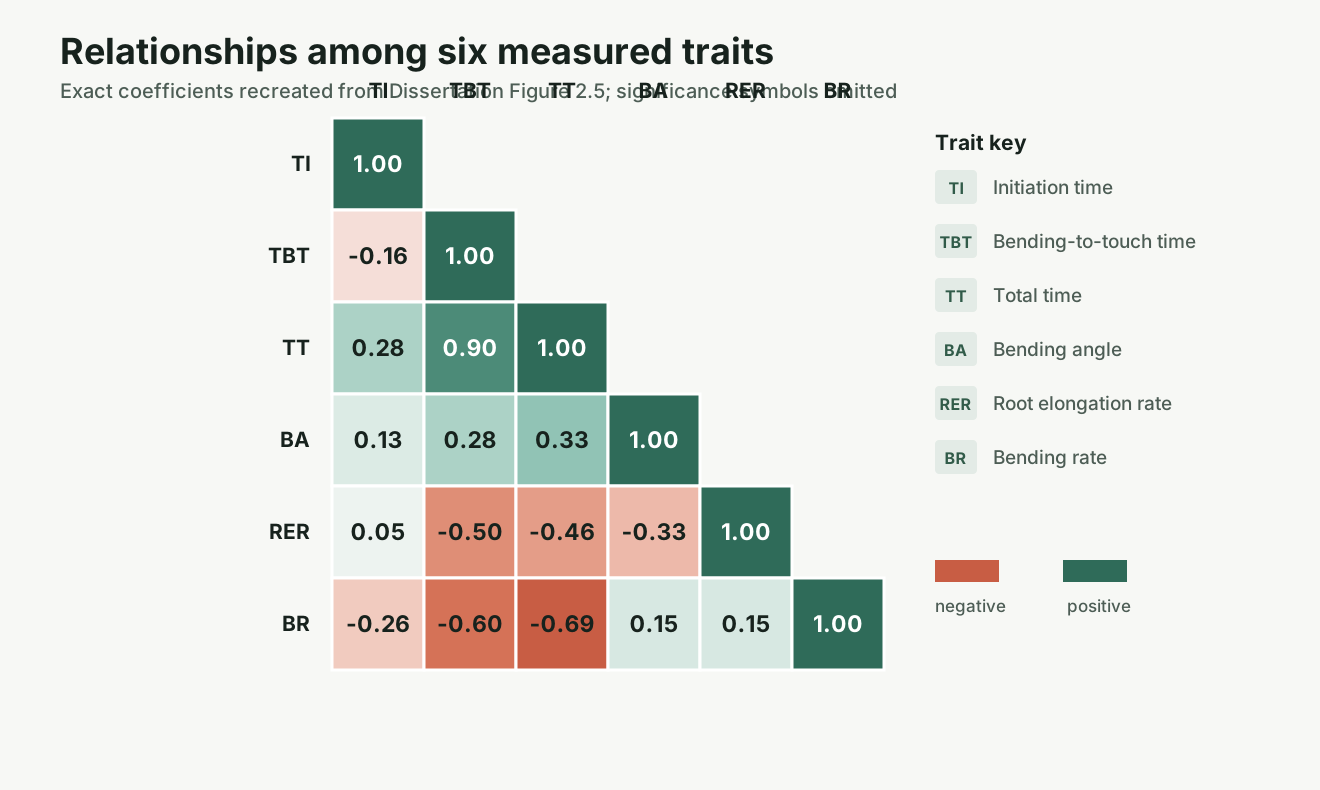
Exact coefficients from Dissertation Figure 2.5; significance symbols are omitted.
Genetic analysis
TASSEL supported genotype quality control, while GAPIT supported GWAS/QTL-oriented analysis with population-structure, kinship, significance-threshold, and linkage-disequilibrium considerations.
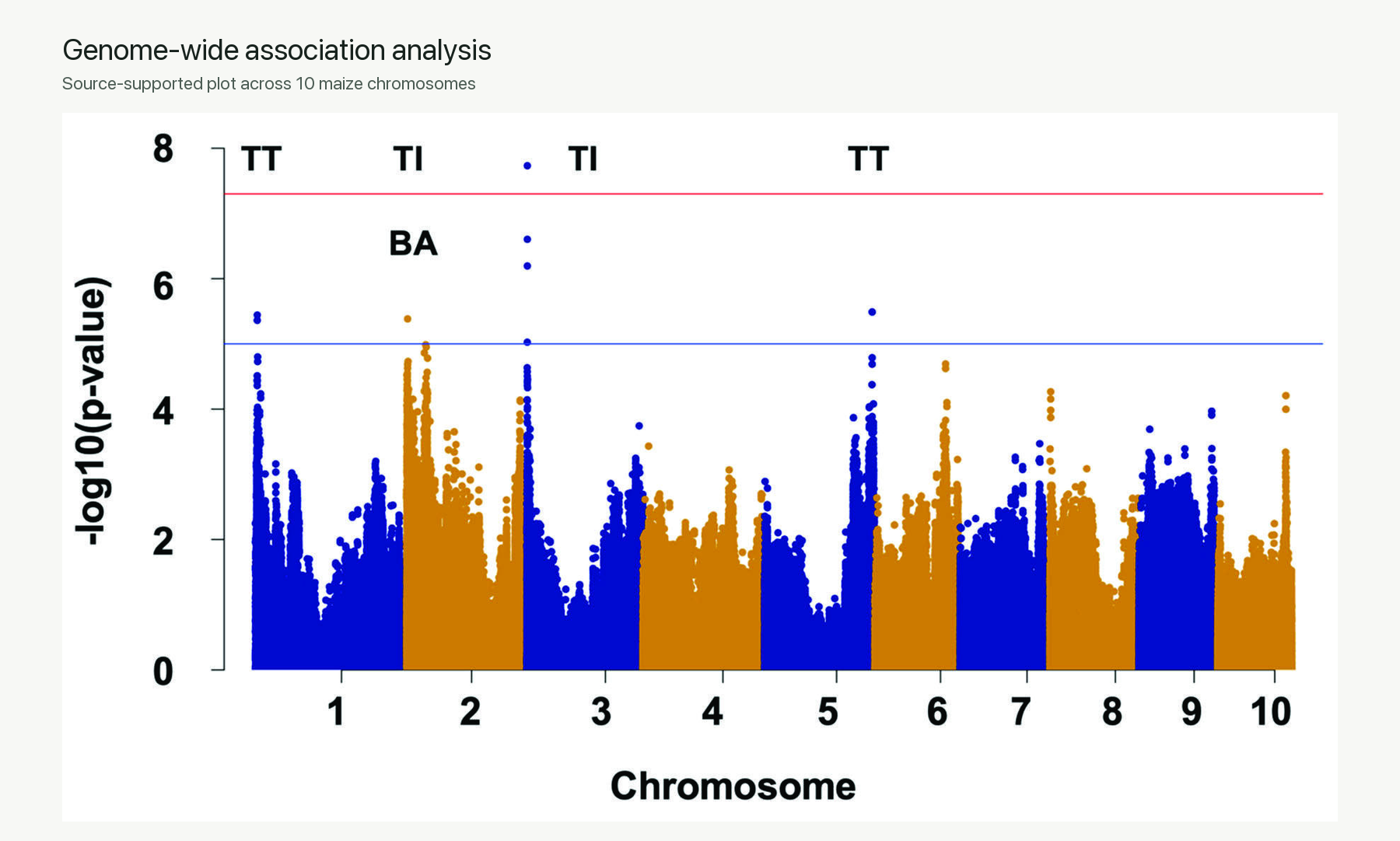
Derived from Dissertation Figure 3.5. Specific loci and candidate genes are not interpreted here.
Outputs
- controlled measurement and time-series image/video records;
- quantitative traits and documented R workflows;
- scientific figures plus GWAS/QTL-oriented and candidate-region analyses;
- a doctoral dissertation and authored or co-authored research artifacts.
Associated verified outputs include the 2025 dissertation Physiological and Genetic Studies of Hydrotropism in the Maize Primary Root and coauthorship of the 2020 New Phytologist article “Hydrotropism in the primary roots of maize.”
Limitations
- The work quantified phenotypic responses but did not directly test every proposed molecular or hormonal mechanism.
- Controlled experimental systems support precise comparisons but do not by themselves establish field-scale agronomic outcomes.
- No claim is made here about improved yield, enhanced drought tolerance, commercial readiness, or field validation.
- Specific loci, candidate genes, effect sizes, genotype-level outcomes, and comparative performance claims are not published on this site.
- The Hydrotropism Analyzer is described as a research system, not a commercial product or generally available instrument.
Transferable capabilities demonstrated
- translating a scientific question into a measurable experiment;
- building a repeatable image and time-series measurement workflow;
- analyzing experimental and genetic data in R;
- producing interpretable figures and technical documentation;
- separating measured evidence, statistical association, interpretation, and unresolved mechanism.